
Intensive course A1
Intensive course A1
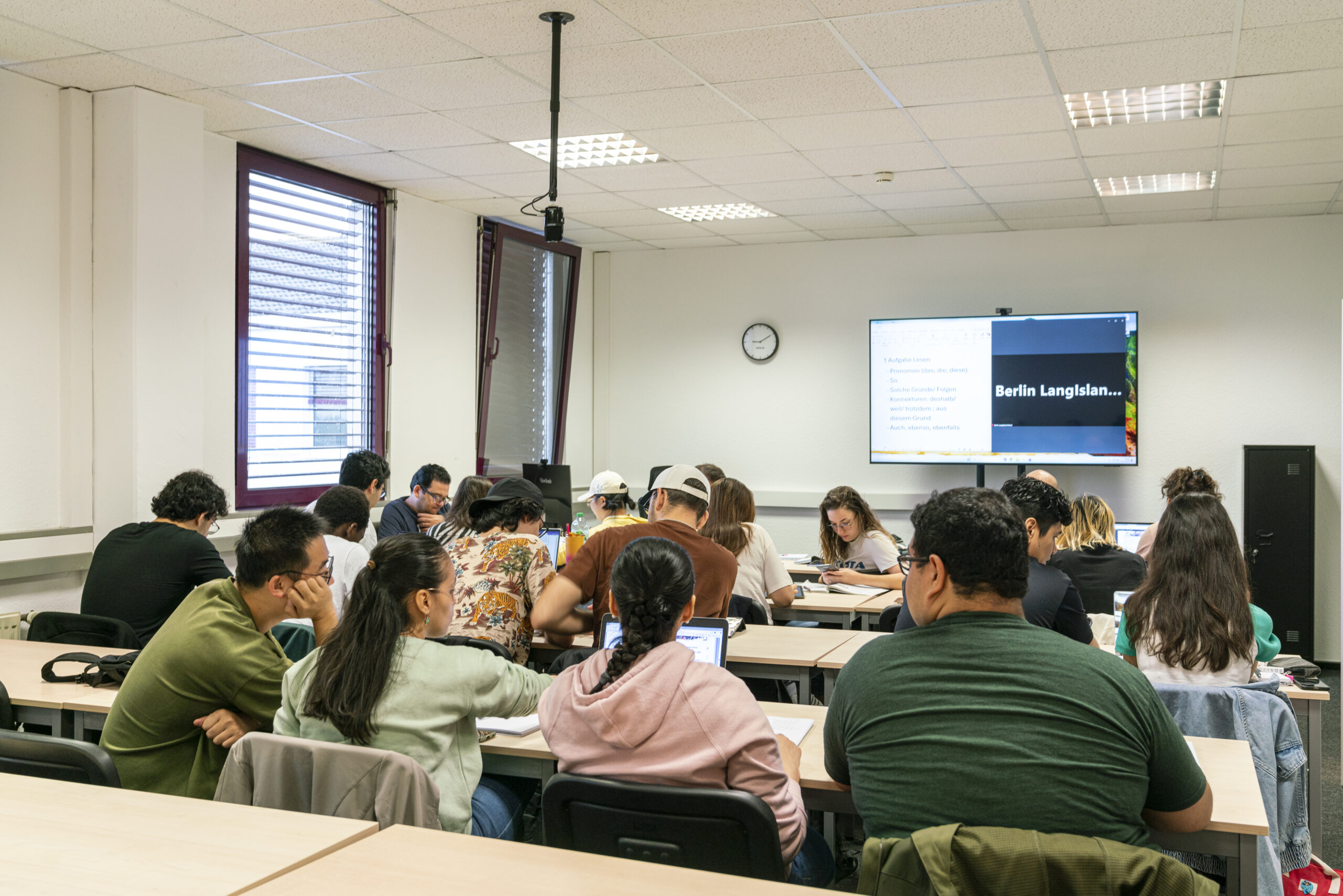

Gentle start

Speaking from day 1

Learning in everyday situations

Clear learning guidance
German Intensive Course A1
Your introduction to the German language – practical & structured
What you learn
-
Everyday language for living, shopping & leisure
-
Basic Grammar & Vocabulary
-
Conducting initial short conversations with confidence
This is how you learn
-
structured intensive lessons
-
visual materials & digital learning platform
-
regular feedback
Who is it suitable for?
-
No prior knowledge required
-
Ideal for studies, everyday life & visas
🕒 Lesson times:
Monday–Thursday, morning or afternoon
579,00 €
More
Information
All important details about Intensive course A1 You can find it here:
📋 Course structure
-
Duration: approx. 7 weeks
-
Scope: 18 lessons per week
-
Format: Hybrid lessons (simultaneously online & on-site in Bochum – you decide how you participate)
-
Completion: Language certificate according to CEFR (A1)
🕒 Lesson times
Monday to Thursday
- Morning course
8:00 – 11:15 am - Afternoon course
13:00 – 16:15
💡 What you will learn in the A1 course
-
to understand very simple words, sentences and conversations
-
to introduce yourself and exchange ideas using short, simple sentences
-
to handle basic everyday situations linguistically
-
to write simple words, sentences and short texts
-
to apply initial grammatical structures and basic vocabulary
Videos
Course structure
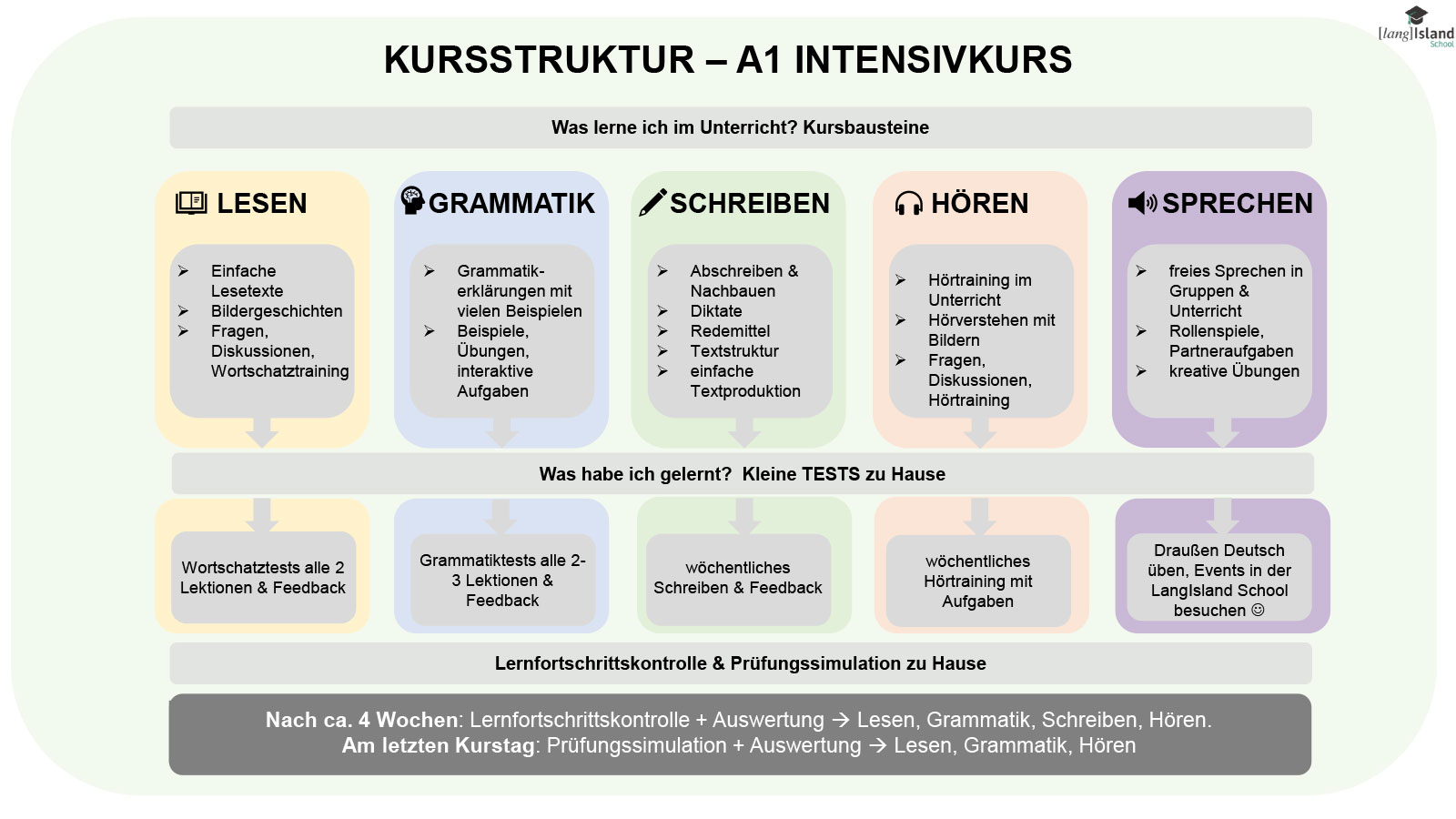
🧠 Main topics
- Introduce yourself (name, age, origin, profession)
- Greeting and saying goodbye to others
- Ask and answer how someone is doing (“How are you?”)
- Talking about family, friends and hobbies
- Food & Drinks
- Days of the week / Months / Seasons
- Order in a café or restaurant
- Health
- Asking for directions and understanding simple directions
- Shopping: Inquire about prices, quantities, and products
- Make an appointment (e.g., with the doctor, at the hairdresser)
- Understand and say numbers 1–1000; ordinal numbers: the first, the second, etc.
(Basic knowledge)
🔤 Grammatical topics
- Definite articles: der / die / das
- Indefinite articles: a / an / an
- Plural formation (e.g. table → tables, woman → women)
- Imperative
- genus
- Nominative/ Accusative / Dative
- Personal pronouns
- Regular verbs (e.g., to make, to play, to live)
- Irregular verbs (e.g., to be, to have, to go, to speak)
- Modal verbs (must, can, want, may – in their basic form)
- Separable verbs (e.g., to get up, to shop)
- Verbs with accusative/dative case (e.g., brauchen + accusative)
- Declarative sentence (subject + verb + complement)
a. “I’m going to the cinema today.” - Yes/No questions
a. “Are you going to the cinema?” - W-questions
a. Who? What? Where? When? How? Why? - Negation with nicht and kein/keine
a. “I don’t have a car.” / “I don’t go to the cinema.” - Stating times: “It is five o’clock.”
- Times of day: morning, noon, evening, night
- Local prepositions: in, an, auf, bei, zu, nach
- Temporal prepositions: am, im, um, von … bis, seit
- Two-way prepositions (with dative/accusative): in, on, under, over, in front of, behind, next to
- Possessive pronouns (my, your, his, her…)
- Adjectives at A1 level (basic forms: big, small, beautiful, old, young)
- Past tense verbs “haben” / “sein”
- Perfect tense – Introduction to the most important verbs
Still have questions? We’ll advise you personally.
Our team will gladly help you with course selection, level & registration.


This is what our students say